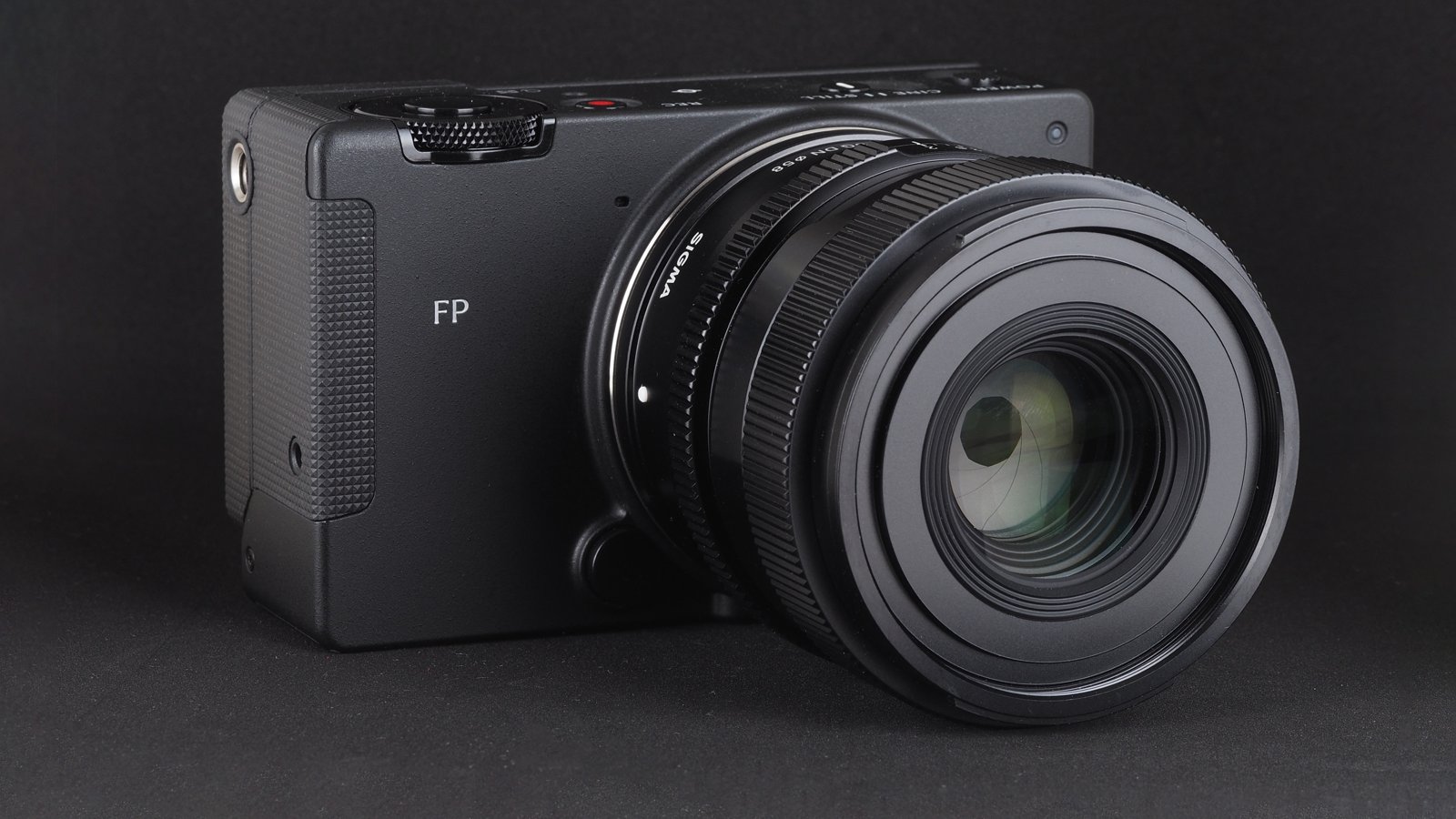
The Sigma FP2 is the second-generation ultra-compact full-frame camera in the fp line. It is priced at $2,199 body only and is due to ship on November 11. It is the world’s smallest full-frame interchangeable-lens camera. That is less obvious than it sounds, because the body is almost entirely redesigned and still manages to be smaller than the first fp even with a bigger battery and a tilting screen. You can now pre-order at B&H Photo Video/Amazon.
Price and kits
- Body only: $2,199
- With the new EVF-21 viewfinder: $2,749
- With the I series 50mm F2 DG lens: $2,749
Those figures and the November 11 date come from DPReview. Sigma’s US product page lists the body at $2,199 and shows “Reserve Online Order.”
The sensor is the story
The FP2 uses a partially stacked 24.6MP CMOS sensor (Sigma’s effective pixel count). DPReview explains it as a BSI sensor with extra readout circuitry around the edges, which gives faster readout without the cost of a fully stacked design, and says it is reasonable to expect it to be comparable to the sensors in the Nikon Z6III and Panasonic S1II. Like Sigma’s other full-frame cameras, the FP2 has no mechanical shutter, so readout speed decides how much rolling shutter you get.
- Flash sync is 1/50 s (1/60 s or slower in crop mode). DPReview says that is nearly twice as fast as the original fp’s fastest, 12-bit readout mode, but still limits what the camera can do for stills.
- Continuous shooting reaches 20 fps for 200 JPEGs or 180 DNGs. At 8 fps it holds 3,000 JPEGs or 630 DNGs.
- Autofocus adds bird recognition for the first time, next to human and dog/cat detection with eye AF. Sigma rates it down to -5 EV.
- Stabilization is electronic and for video only. There is no in-body stabilization.
Video
- 6K open gate (full sensor) up to 60p. Sigma notes it cannot be combined with electronic stabilization.
- ProRes RAW (standard or HQ) up to 6K/30, written to an external SSD only. Bit rates reach 5,800 Mbps in HQ and 3,900 Mbps in standard, well beyond what the UHS-II card slot can take.
- 4K up to 60p from the full sensor width, 120p with a crop. 2K up to 120p.
- 10-bit internal recording, with the option to use Leica’s L-Log. Sigma says 7 stops of headroom is reserved for highlights in Log and RAW, so everything below ISO 1250 is an extended setting.
- Director’s Viewfinder mode now includes more Red, Arri and Sony cinema cameras, among them the ARRI ALEXA 35 and Sony VENICE 2 / BURANO, plus desqueeze ratios for anamorphic lenses.
Body, ports and battery
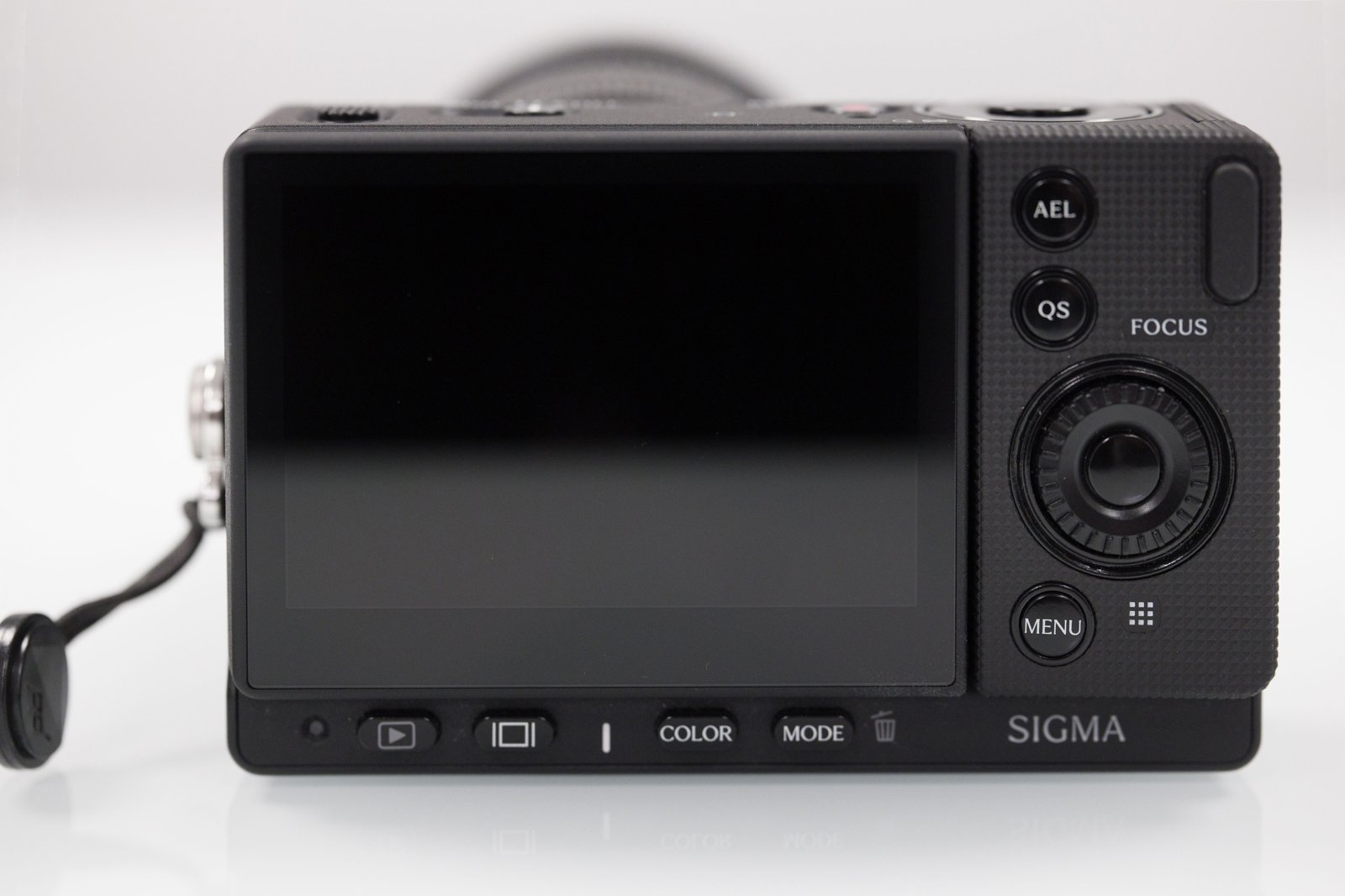
Sigma gives the body as 112.8 × 69.9 × 41.8 mm. It weighs 388 g without the battery and 446 g with it, according to Sigma. DPReview lists 460 g with battery and card. The rear screen is a 3.15″, 2.1M-dot touch LCD that tilts up 90° and down 45°. DPReview says the tilt also helps cooling during long video recording, and Sigma quotes up to 2 hours of continuous recording.
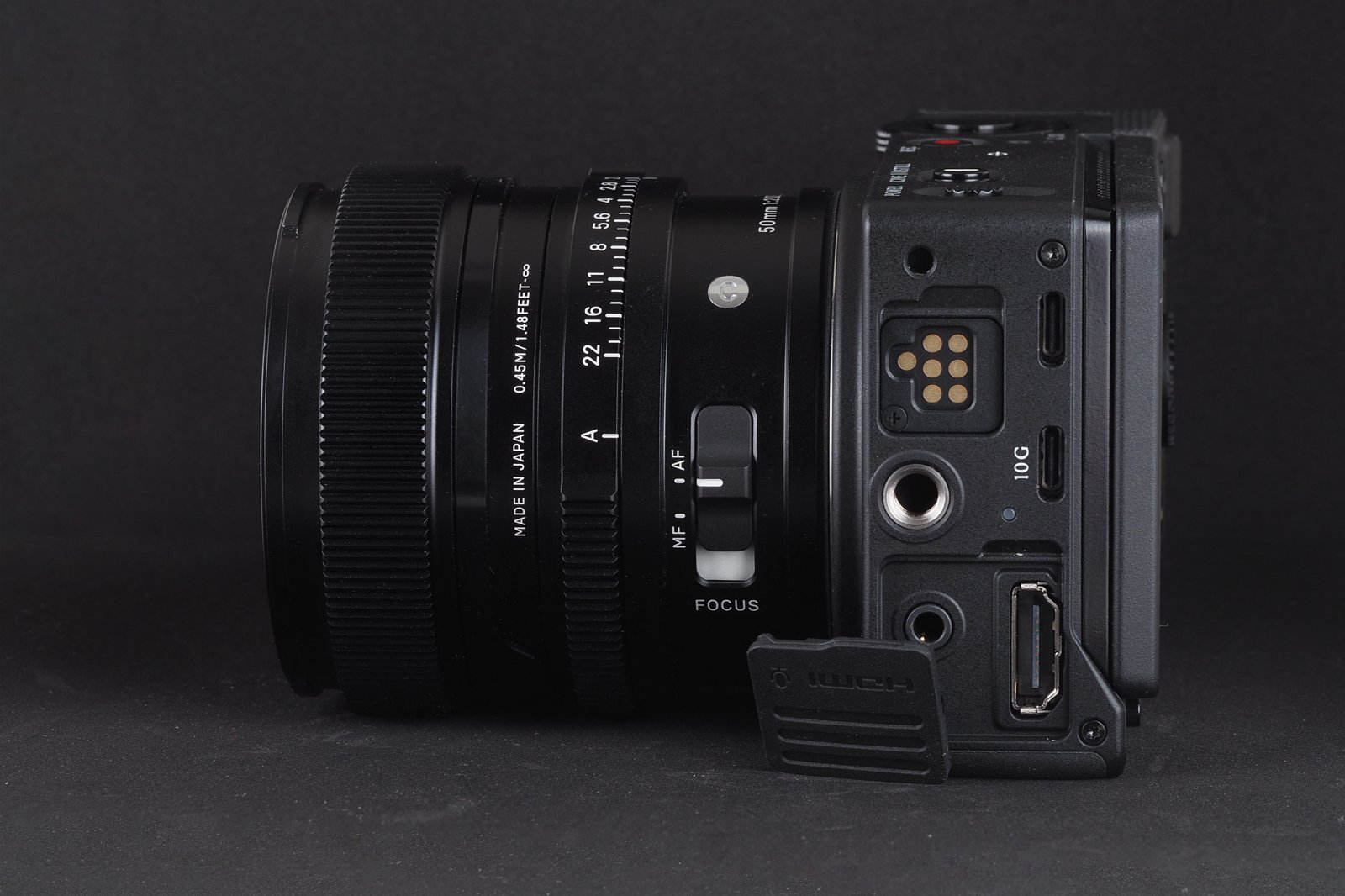
Two USB-C ports do much of the work. The upper one is USB 2.0 speed and handles power, headphones or mic, the CR-51 cable release, and the EVF-21. The lower one is a 10Gbps USB 3.2 Gen 2 port for an SSD, fast transfers, power and UVC/UAC webcam use, and it can carry headphones, mic or cable release too. There is no dedicated headphone jack, but either USB-C port can serve for it. A full-size HDMI socket replaces the original’s micro HDMI, a 7-pin interface carries the new hotshoe unit, and the 3.5mm mic input also supports plug-in power and timecode.
| Sigma FP2 | Original fp (per DPReview) | |
|---|---|---|
| Battery | BP-91, 16Wh | BP-51, 8.6Wh |
| Shots per charge | About 370 shots | 280 shots |
| Color modes | 13 (adds Rich, Calm, 709 Look) | 16 |
| HDMI | Full-size | Micro |
| Internal video | 10-bit, L-Log | 8-bit (or Cinema DNG to SSD) |
The new BP-91 battery looks like, and is cross-compatible with, Panasonic’s BLK-22. The camera is dust and splash resistant, which Sigma says covers light rain but is not the same as being waterproof.
Accessories
- EVF-21: a 5.76M-dot OLED viewfinder (1600 × 1200) with an eye sensor. It plugs into the upper USB-C port instead of using both USB and HDMI as the old one did, and it blocks the 7-pin interface even though it does not use it.
- HU-21 hotshoe unit: works with the flash protocol shared by OM System and Panasonic, including Godox flashes made for those systems. It also takes Panasonic hotshoe mics and the DMW-XLR2 adapter, which is how the camera records 32-bit float audio.
- LVF-21 LCD viewfinder: a hood and loupe for use with the screen flat against the back.
- The original HG-11 grip and SH-11 strap lugs carry over. Sigma also lists a BPL-21 base plate, CR-51 cable release and BC-91 charger.
What to take from it
DPReview notes that Sigma’s owner has long been disappointed that the first fp was read mainly as a cinema camera. The FP2 gives stills shooters more reasons: a faster sensor, a high-resolution viewfinder, and a flash system that works with a widely used standard. Electronic shutter only is still the main limit. Video shooters get ProRes RAW, a 10-bit log profile and a full-size HDMI port, which DPReview calls big steps forward. The FP2 also leans on its L-mount partners for much of this: the Panasonic-compatible battery and flash protocol, and Leica’s L-Log. DPReview says it has not had much time with the camera yet. Its sample images and full testing will follow, so image quality verdicts are still to come.